
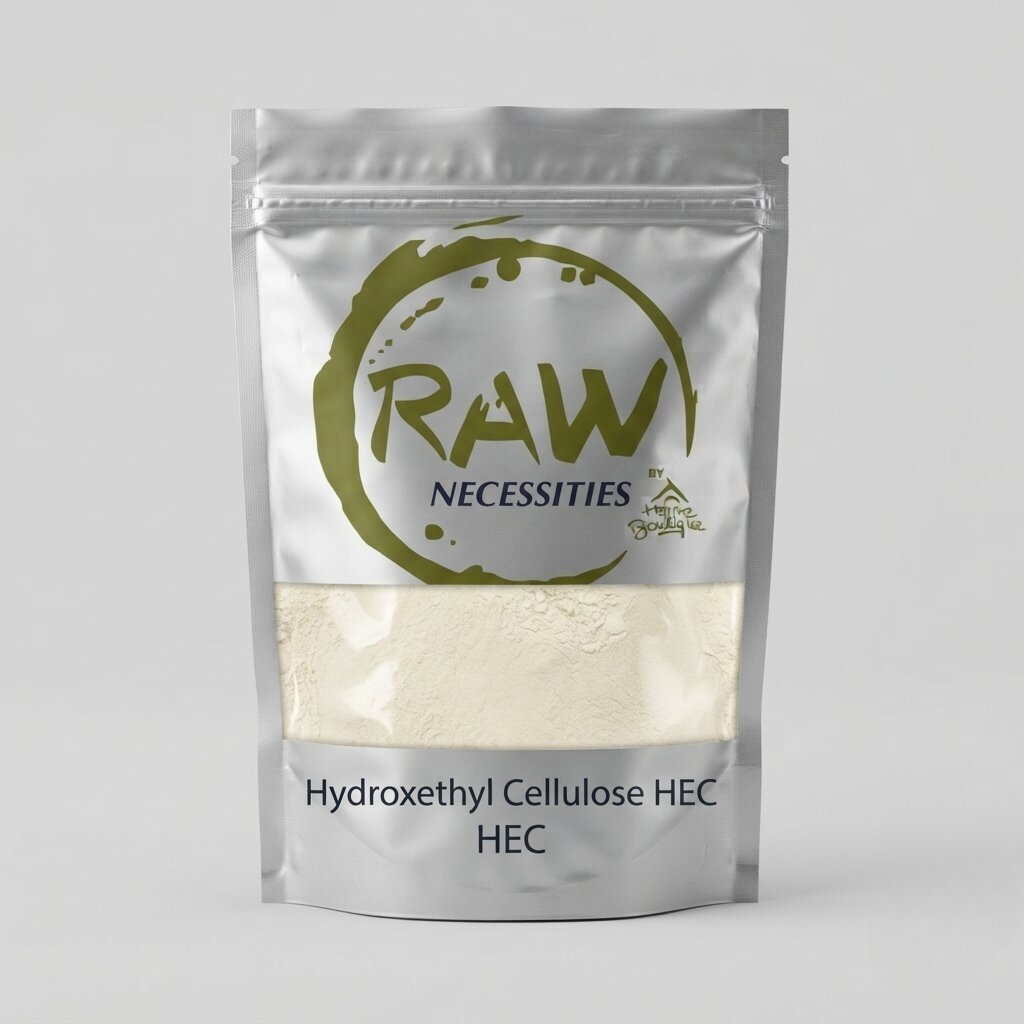
Hydroxethyl Cellulose HEC (standard technical name: Hydroxyethyl Cellulose) is a versatile, water-soluble cellulose-derived polymer widely used as a thickening agent, rheology modifier, stabilizer, suspending aid and texture enhancer in cosmetic and personal care formulations.
HEC helps increase viscosity and improve the flow, consistency and sensory profile of water-based formulations. It is particularly useful for creating smooth, uniform gels, creams, lotions, shampoos, conditioners, cleansers and other personal-care products.
Its nonionic nature makes Hydroxyethyl Cellulose a versatile formulation ingredient that can be used across a broad range of cosmetic systems, subject to grade-specific compatibility and processing requirements.
INCI Name
Hydroxyethylcellulose
Common Names
- Hydroxethyl Cellulose HEC
- Hydroxyethyl Cellulose
- Hydroxyethylcellulose
- HEC
- Cellulose Hydroxyethyl Ether
- Hydroxyethyl Cellulose Polymer
- Cosmetic HEC
- Cellulose-Based Thickener
- Water-Soluble Cellulose Polymer
- Cosmetic Rheology Modifier
- HEC Thickener
Chemical Information
| Property | Details |
|---|---|
| Product Name | Hydroxethyl Cellulose HEC |
| Standard Technical Name | Hydroxyethyl Cellulose |
| INCI Name | Hydroxyethylcellulose |
| CAS Number | 9004-62-0 |
| Chemical Family | Cellulose Ether |
| Polymer Type | Nonionic Water-Soluble Polymer |
| Source | Cellulose-derived |
| Primary Function | Thickener & Rheology Modifier |
| Physical Form | Powder |
| Water Solubility | Water soluble/dispersible, grade dependent |
Ingredient Type
- Cosmetic Thickener
- Rheology Modifier
- Viscosity Modifier
- Stabilizer
- Suspending Agent
- Texture Modifier
- Film-Forming Polymer
- Water-Soluble Polymer
- Cellulose-Based Functional Ingredient
Key Functions
1. Thickening Agent
Hydroxyethyl Cellulose increases the viscosity of aqueous formulations, helping create the desired consistency and product texture.
2. Rheology Modifier
Helps control the flow and application characteristics of water-based cosmetic products.
3. Stabilizer
Can contribute to formulation stability by helping maintain a uniform product structure.
4. Suspending Aid
Useful in suitable formulations where improved suspension of dispersed materials is required.
5. Texture Enhancement
Helps create smooth, consistent and pleasant textures in gels, cleansers, shampoos and other personal-care products.
6. Film Formation
Depending on grade and formulation, HEC can contribute to film-forming properties and improve the cosmetic feel of finished products.
Key Benefits
Smooth & Uniform Texture
Helps provide a smooth, consistent texture across a variety of water-based formulations.
Viscosity Control
Allows formulators to adjust viscosity according to the desired product format and sensory profile.
Water-Soluble Polymer
Its water-soluble nature makes it particularly suitable for aqueous cosmetic and personal-care systems.
Versatile Formulation Ingredient
Can be used in skin care, hair care, cleansing, bath and personal-care formulations.
Excellent for Gel Systems
Useful for developing clear or translucent gel-type formulations, depending on the grade and complete formulation.
Improved Product Handling
Helps create formulations with suitable flow, spreadability and application characteristics.
Applications
Skin Care
Hydroxyethyl Cellulose HEC can be used in:
- Face Gels
- Hydrating Gels
- Facial Serums
- Gel Creams
- Moisturizers
- Face Creams
- Lotions
- Facial Masks
- Body Lotions
- Body Gels
- Hand Creams
- Skin Care Gels
Hair Care
Suitable for:
- Shampoos
- Conditioning Shampoos
- Hair Conditioners
- Hair Masks
- Hair Gels
- Hair Serums
- Leave-In Products
- Hair Styling Products
- Scalp Care Formulations
- Hair Creams
- Hair Lotions
Cleansing & Bath Products
Suitable for:
- Face Wash
- Facial Cleansers
- Body Wash
- Shower Gel
- Hand Wash
- Liquid Soap
- Bath Products
- Cleansing Gels
- Personal Hygiene Products
Other Personal Care
Can also be used in:
- Shaving Products
- After-Shave Products
- Deodorant Gels
- Hand Sanitizing Gel Systems
- Aloe Vera Gels
- Massage Gels
- Cosmetic Treatment Gels
Recommended Usage
A general cosmetic starting range is approximately:
0.2–2.0%
The optimum concentration depends on:
- HEC viscosity grade
- Degree of substitution
- Desired finished viscosity
- Product type
- Processing method
- Other polymers and ingredients in the formulation
How to Use
Hydroxyethyl Cellulose should generally be properly dispersed before complete hydration.
General Processing Method
- Prepare the required quantity of water.
- Begin moderate and consistent mixing.
- Slowly sprinkle HEC into the water while mixing.
- Avoid adding the powder all at once to prevent lump formation.
- Allow sufficient hydration time.
- Continue mixing until the polymer is uniformly hydrated.
- Add remaining formulation ingredients according to the formulation process.
- Adjust final viscosity and pH as required.
- Check the finished product for appearance, viscosity and stability.
Pre-Dispersion Method
For easier processing, HEC can sometimes be pre-dispersed in a suitable non-aqueous component such as glycerin before addition to the aqueous phase.
Formulation Considerations
- Add gradually to prevent clumping.
- Allow adequate hydration time.
- Mixing speed should be sufficient for dispersion without unnecessarily incorporating excessive air.
- Final viscosity depends strongly on polymer grade and concentration.
- Evaluate compatibility with salts, surfactants, preservatives and other polymers.
- Check the effect of pH and electrolytes on the final formulation.
- Different HEC grades provide different viscosity profiles.
- Conduct stability testing before commercial production.
Compatible Ingredients
Hydroxyethyl Cellulose can be used with many common cosmetic ingredients, including:
- Glycerin
- Propanediol
- Butylene Glycol
- Aloe Vera
- Panthenol
- Hyaluronic Acid
- Sodium PCA
- Betaine
- Niacinamide
- Botanical Extracts
- Surfactants
- Mild Cleansing Agents
- Emollients
- Humectants
- Preservatives
- Other Rheology Modifiers
- Cosmetic Actives
Suitable Product Types
Hydroxethyl Cellulose HEC is suitable for formulating:
- Face Wash
- Facial Gel
- Aloe Vera Gel
- Hydrating Gel
- Face Serum
- Gel Cream
- Moisturizing Lotion
- Body Lotion
- Shampoo
- Conditioner
- Hair Gel
- Hair Serum
- Body Wash
- Shower Gel
- Hand Wash
- Liquid Soap
- Shaving Gel
- Personal Care Gels
Technical Product Information
| Property | Details |
|---|---|
| Product Name | Hydroxethyl Cellulose HEC |
| Standard Name | Hydroxyethyl Cellulose |
| INCI | Hydroxyethylcellulose |
| CAS No. | 9004-62-0 |
| Chemical Family | Cellulose Ether |
| Polymer Type | Nonionic |
| Source | Cellulose-derived |
| Physical Form | Fine Powder |
| Appearance | White to off-white powder, grade dependent |
| Solubility | Water soluble |
| Primary Function | Thickener |
| Secondary Functions | Rheology Modifier, Stabilizer, Suspending Aid, Film Former |
| General Usage | 0.2–2.0% |
| Applications | Skin Care, Hair Care, Cleansing, Bath & Body |
| Product Type | Leave-On & Rinse-Off |
| Exact Viscosity | Grade dependent |
| Exact Specifications | Refer to TDS/COA/SDS |
Why Choose Hydroxethyl Cellulose HEC?
- Versatile cellulose-derived thickener
- Water-soluble formulation aid
- Effective viscosity modifier
- Useful for gel and liquid formulations
- Supports smooth and uniform product texture
- Suitable for skin and hair care
- Useful in cleansing and personal-care systems
- Nonionic polymer
- Suitable for a wide range of cosmetic formulations
- Available in different viscosity grades
- Excellent ingredient for professional cosmetic formulation
Storage
Store Hydroxethyl Cellulose HEC in a cool, dry and well-ventilated area in a tightly closed original container.
Protect from:
- Moisture
- High humidity
- Direct sunlight
- Excessive heat
- Contamination

Reviews
There are no reviews yet.