
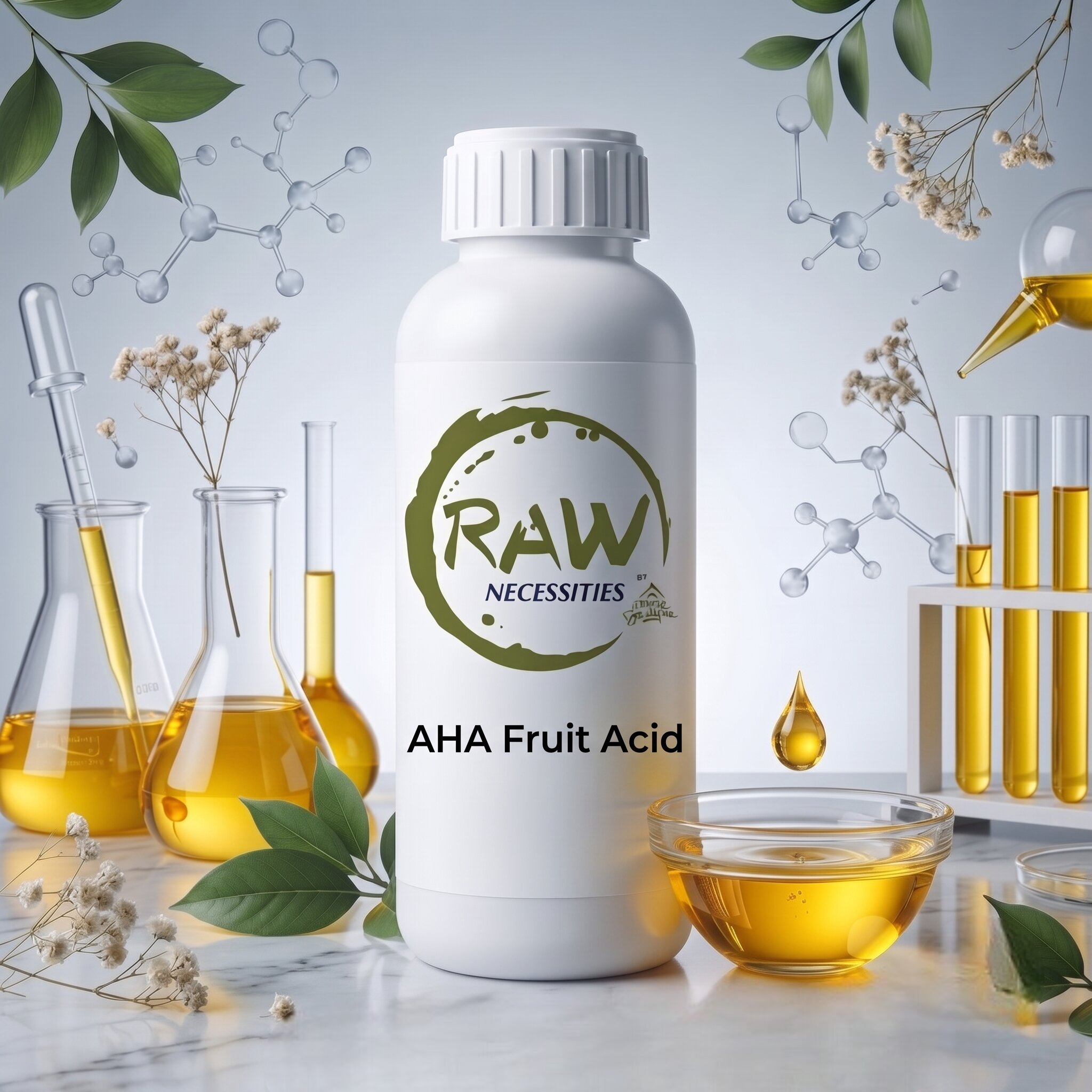


🧴 Detailed Product Description
AHA Fruit Acid Liquid is a cosmetic exfoliating active designed for skincare formulations targeting dull, uneven, rough and blemish-prone skin.
AHA stands for Alpha Hydroxy Acids. Depending on the supplier, an AHA fruit-acid blend can contain combinations of glycolic acid, lactic acid, citric acid, malic acid and tartaric acid, together with botanical fruit/plant extracts.
These acids are used in cosmetic formulations to support exfoliation and skin renewal, helping remove dead surface skin cells and improve the appearance of skin texture and radiance.
It is particularly suitable for face serums, creams, lotions, exfoliating products, peeling gels, masks and cleansing gels, depending on the exact concentration and pH of the supplied material.
🌿 Key Active Acids
A typical AHA Fruit Acid Blend can contain:
1. Lactic Acid
An AHA commonly used in skincare for exfoliation and improving the appearance of skin texture.
2. Glycolic Acid
A small-molecule AHA widely used in cosmetic exfoliating formulations.
3. Citric Acid
An organic acid used in cosmetic formulations and AHA blends.
4. Malic Acid
A naturally occurring fruit acid used as part of some AHA blends.
5. Tartaric Acid
A naturally occurring organic acid found in fruit and used in some cosmetic AHA formulations.
One commercial AHA blend specifies approximately 30% lactic acid, 12% glycolic acid, 2% citric acid and 0.5% tartaric acid, but do not use these percentages for your product unless your supplier’s TDS confirms them.
⭐ Key Cosmetic Benefits
- Helps exfoliate dead surface skin cells
- Supports smoother-looking skin
- Helps improve the appearance of skin texture
- Supports a more radiant-looking complexion
- Suitable for dull-looking skin
- Useful in blemish-prone skin formulations
- Supports skin-renewal-focused formulations
- Can be used in anti-ageing cosmetic formulations
- Useful for exfoliating and peeling products
- Water-soluble cosmetic active
AHA fruit-acid products are commonly marketed for exfoliation, radiance, smoothing and skin-renewal applications.
🧖♀️ Skin Care Applications
Face Care
- Face Serum
- Facial Cream
- Face Lotion
- Brightening-style formulations
- Radiance creams
- Anti-ageing formulations
- Exfoliating face products
Exfoliation
- AHA Peeling Gel
- Exfoliating Gel
- Facial Peel
- Chemical-exfoliation formulations
- Exfoliating Mask
- Scrub formulations
Cleansing
- Face Wash
- Cleansing Gel
- Purifying Cleansing Gel
Body Care
- Body Lotion
- Body Cream
- Body Exfoliating Products
- Rough-skin care formulations
Commercial AHA fruit-acid blends list applications such as anti-ageing/anti-wrinkle creams and lotions, peeling gels and exfoliants.
💧 Physical & Technical Properties
For a commonly sold AHA Fruit Acid Blend:
| Specification | Details |
|---|---|
| Product Name | AHA Fruit Acid Liquid / AHA Fruit Acid Blend |
| Category | Cosmetic Skin Care Active |
| Type | Alpha Hydroxy Acid Blend |
| Physical Form | Liquid |
| Appearance | Clear to slightly hazy liquid |
| Colour | Colourless to light yellow, grade dependent |
| Solubility | Water-soluble |
| Main Application | Skin Care |
| Main Function | Exfoliation / Skin Renewal |
| Typical Acids | Lactic, Glycolic, Citric, Malic & Tartaric Acid |
| pH | Grade dependent |
| Usage Level | Supplier TDS dependent |
| Storage | Cool, dry and light-protected place |
For example, one commercial AHA blend specifies pH 4–5 and water solubility, while another fruit-acid product has a much lower pH of 1.2–2.5. This is why your exact product’s TDS is important before publishing pH or dosage.
🧪 INCI – Important
A common AHA Fruit Acid Blend may use an INCI such as:
Water (Aqua), Lactic Acid, Glycolic Acid, Citric Acid, Malic Acid, Tartaric Acid, Vaccinium Myrtillus Fruit Extract, Saccharum Officinarum (Sugarcane) Extract, Citrus Aurantium Dulcis (Orange) Fruit Extract, Citrus Limon (Lemon) Fruit Extract, Acer Saccharum (Sugar Maple) Extract
However, INCI differs between suppliers, so please use your supplier’s exact INCI on your website.
🍇 Fruit & Botanical Sources
Some AHA Fruit Acid blends use extracts from:
- Bilberry
- Sugarcane
- Orange
- Lemon
- Sugar Maple
One commercial formulation describes the blend as containing fruit/plant extracts together with AHA acids.
🎯 Ideal Skin Types
Suitable for cosmetic formulations intended for:
- Dull-looking skin
- Uneven-looking skin
- Rough skin texture
- Blemish-prone skin
- Oily skin
- Mature-looking skin
- Normal skin
🧴 Suitable Formulations
✔ Face Serum
✔ Face Cream
✔ Facial Lotion
✔ AHA Gel
✔ Peeling Gel
✔ Exfoliating Mask
✔ Face Wash
✔ Cleansing Gel
✔ Body Lotion
✔ Body Exfoliant
📌 Recommended Usage
Do not publish a universal dosage unless it matches your supplier’s specification.
For reference, different commercial products give substantially different recommendations:
- One fruit-acid active: 1–5% for regular application and 5–10% for a one-off peeling effect.
- Another AHA blend: 1–4% depending on skin tolerance.
- Another supplier lists 5–15%, showing why the exact grade matters.
For your website, safest wording is:
“Recommended Usage: As per manufacturer’s technical specification and final formulation requirements.”
⚗️ Formulation Notes
AHA products are acidic, so the final formulation’s pH is important. Adding an AHA blend can change the pH and may affect the stability of an emulsion.
For formulation work:
- Add according to supplier instructions.
- Check final product pH after incorporation.
- Test formulation stability.
- Introduce into the appropriate aqueous/cool-down phase according to the supplier’s TDS.
- Avoid blindly combining with incompatible alkaline ingredients.
- Conduct a small-scale compatibility test before commercial production.
One supplier specifically recommends adding its AHA blend to the aqueous phase below 40°C.



Reviews
There are no reviews yet.